The Congregation Divided:
A History of Deaf Religious Segregation, 1895-1955
The Whatcoat Mission

Fig 1: Orchard Street Church (undated)
Prior to the creation of religious services by and for deaf people, the graduates of deaf residential schools interested in the continued expression of their faith were limited in their options. Established religious services, for hearing congregants, relying heavily on spoken language and religious hymns would provide little outlet for non-speaking, deaf adherants. This problem was further complicated by the development of segregated religious services. Prior to the creation of the Whatcoat Mission in Baltimore, it is unclear how or where black deaf congregants would have worshipped. However, as a result of this mission congregants gained access to spiritual and social support that would serve them for over 100 years.
In the beginning Moylan reached out to his former students at the Maryland School for the Colored Deaf and encouraged them to attend bible study classes.1 The oral history of Charles Waters provided insight into the initial work. Moylan would visit black deaf people in their homes for bible study. As interest grew, Moylan sought out a location for the group to meet.2 As early as 1897, Moylan aided Rev. Young at the Asbury Methodist Episcopal church in ministering to deaf congregants but is unclear how regularly this task was undertaken. On January 1, 1905, Moylan held the first meeting of the Whatcoat Mission for Colored Deaf. The Mission was named for the Whatcoat-Epsworth church that housed them. Moylan’s motivations for establishing a mission for African American deaf people in Baltimore are unclear. While he “knew many of the people personally and began this mission for them out of concern for their spiritual welfare” he provided no written documentation of his reasons.3 It would seem that social ideology at the time influenced his decision to establish a separate congregation rather than join it with an existing one. There is also some indication that “proper white deaf” didn’t want to be associated with black deaf people and Moylan acceded to this pressure.4
Moylan’s register indicated that there was some difficulty in the beginning. He wrote “I confined my work to the Colored deaf at Whatcoat Mission with very little apparent encouragement, but after a little more patience I began to see my work appreciated.”5 Ten people attended the first meeting, but the number increased in size over time to forty.6 Without a formal church building, the mission was at the whim of the facility that housed them. Due to the low contributions collected at the meetings and difficulty securing space, the mission moved frequently, but kept the name Whatcoat. During this time an assistant, Charles Branflick, a white, deaf man, aided Moylan in his ministry. Branflick was also engaged as an Episcopal preacher at Grace Church. Layreaders were also added and Jerome Horsey and Charles Waters, both black and deaf, served in this capacity through the 1950s.7
Residential deaf schools brought deaf people together and created a culturally and lingusitically rich environment for students and staff. Unpon graduation, however, graduates would often return to families and take jobs that would put them in contact with a hearing and speaking world that was critical of, or resistant to, deaf behaviors and the use of sign language. White deaf students often found support in local, state or national deaf associations formed by, and for, white deaf Americans. African American deaf individuals experienced barriers in accessing these deaf clubs and organizations.9 Separate church services “allowed members to claim their unique identity, while also reinforcing their image as ‘normal,’ upstanding citizens.”10 Social organizations like the Whatcoat Mission participated in events that were both entertaining and edifying and, importantly, they provided the opportunity to spend time with other black deaf members of the community.11

Fig 2: Members of the Whatcoat Mission in the 1940s.
Here, Rev Moylan’s efforts in Baltimore are best understood. Both black and white people living and working in Baltimore likely sought out the comfort of ministry not only for worship but also for crucial social and welfare purposes. “The church has not only afforded means of worship for its members, but also an organization that has indirectly promoted sociability among the mutes of the city.”12 Because deaf people experienced barriers in interacting with hearing people, deaf churches served as social and cultural refuges.13 The churches that Moylan constructed certainly satisfied these needs for deaf congregants.
Moylan may have attempted to house both the white congregation of Christ United Methodist Church and the black members of the Whatcoat Mission in the same church building for a brief period in 1917. At the time the Christ United congregation was housed on Schroeder Street in Baltimore. However, Waters indicates that “…some of the white people complained…” and instead they were moved to another church building on Orchard Street.14 This is unsurprising as “Deaf clubs, like most associations of the time, were divided along ethnic and racial lines. The National Association of the Deaf had bylaws that limited membership to ‘any white deaf citizen,” and local clubs followed suit.”15 The segregated practices institutionalized at deaf residential schools were reproduced in the behaviors of adult deaf people.
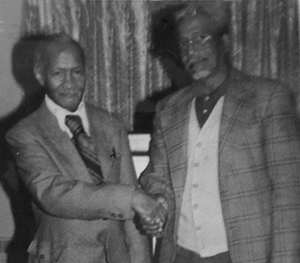
Fig 3: Jerome Horsey and Charles Waters
In the 1940s, after the Christ Methodist congregation purchased a building on Calhoun Street, the separate congregations began to share a building. Though they worshipped in the same place, Moylan would provide separate services. “Rev. Moylan would hold a service for the Whatcoat Mission in the morning and for Christ Church in the afternoon.”16 Further, Waters recalls that they did not worship in the same spaces. “White people had a room upstairs in the church and the Black Deaf met downstairs… not together, we worshiped separately.”17 With the move to the Calhoun street location, “The African-American congregation met in the basement on Sunday mornings while the white congregation worshipped in the sanctuary on Sunday afternoons.”18 Shortly after this change Rev. Daniel Moylan died.
Oral history indicates that after Rev. Moylan passed, Jerome Horsey and Charles Waters took a larger role in continuing the Mission. Waters indicated that Horsey approached him with concerns, "he said he was afraid that maybe the Black Deaf with no church would all slip away and forget church. I asked him what should we do? He said what about you and me take charge of the church?"19 Together they would continue the work begun by Rev. Moylan and in large part, the congregants of the Whatcoat Mission sustained Christ Church until Rev. Foxwell was ordained.
Information regarding the activities and experiences of deaf African Americans in Baltimore in the early twentieth century remains limited. “To date, no significant work – in film or in print has examined African American deaf people’s heritage and culture.”20 There are significant barriers to the collection and presentation of information about the Whatcoat Mission and other organizations. Marginalized communities lack access to institutional support. In this case, the Whatcoat Mission frequently moved and, until the 1940s, did not have access to the same formalized recordkeeping systems in place at permanent institutions. Additionally, the informal social networks in place at this time rarely produced materials like flyers or announcements that were made public. An additional barrier to the collection of resources relies in the ephemeral nature signed language. It is important to note that American Sign Language (ASL, or in some cases, linguistically distinct Black ASL) has no written form. The barriers to literacy that deaf people that experienced greatly prohibited them from recording their lived histories until the advent of film technology
Source materials available in PDF below:


Sources:
Figure 1: "Orchard Street" (undated photo) green binder, Christ United Methodist Church for the Deaf Archives.
Figure 2: "Whatcoat Mission" (1940s) red binder, Christ United Methodist Church for the Deaf Archives.
Figure 3: "Jerome Horsey and Charles Waters" (undated photo) green binder, Christ United Methodist Church for the Deaf Archives.
1. Peggy A Johnson and Robert L Walker, Deaf Ministry: Make a Joyful Silence (Charleston, S.C.: BookSurge, LLC, 2007), 21.
2. The Best Is Yet to Come; The History of the Whatcoat Mission for the Colored Deaf.
3. Johnson and Yates, The History of Christ United Methodist Church of the Deaf, 11.
4. Peggy A Johnson, Interview with Bishop Peggy Johnson, audio, October 14, 2003, pg 1.
5. Daniel E. Moylan, “Early Church Reports of Rev. D.E. Moylan,” Church Register (Baltimore, Maryland, 1905), 3, Christ United Methodist Church for the Deaf Archives.
6. Moylan, “The History of Christ Methodist Church for the Deaf,” 74; Daniel E. Moylan, “Souvenir of the Christ M.E. Church for the Deaf” (Christ Methodist Episcopal Church for the Deaf, undated), 13, Folder: Baltimore - Fulton Seimers Memorial/Christ Church of the Deaf – unnumbered, Lovely Lanes Archives.
7. Dean Snyder, “United Methodists Celebrate Historic Black Deaf Church,” United Methodist News Service, October 23, 2000, Folder: Fulton Siemers Memorial/ Christ Church of the Deaf - Folder 8/8, Lovely Lanes Archives.
8. Daniel E. Moylan, “Early Church Reports of Rev. D.E. Moylan,” Church Register (Baltimore, Maryland, 1905), 3, Christ United Methodist Church for the Deaf Archives.
9. Padden and Humphries, Inside Deaf Culture, 55.
10. Burch, Signs of Resistance, 51.
11. Ernest Hairston and Linwood Smith, Black and Deaf in America: Are We That Different (Silver Spring, Md.: T.J. Publishers, 1983), 37.
12. “News of the Churches: Methodist Deaf Mute Mission To Celebrate Anniversary Work of Presbyterians Mr. James E. Ingram Gives Font As Memorial To His Father--Last Service In Old Trinity Lutheran,” The Sun (1837-1987), April 28, 1906, ProQuest Historical Newspapers.
13. Burch, Signs of Resistance, 48.
14. The Best Is Yet to Come; The History of the Whatcoat Mission for the Colored Deaf.
15. Baynton, Gannon, and Bergey, Through Deaf Eyes, 104.
16. Moylan, “Souvenir of the Christ M.E. Church for the Deaf.”
17. The Best Is Yet to Come; The History of the Whatcoat Mission for the Colored Deaf.
18. Johnson, Interview with Bishop Peggy Johnson; Snyder, “United Methodists Celebrate Historic Black Deaf Church.”
19. The Best Is Yet to Come; The History of the Whatcoat Mission for the Colored Deaf.
20. Susan Burch and Hannah Joyner, Unspeakable: The Story of Junius Wilson (Chapel Hill: University of North Carolina Press, 2007), 3.
